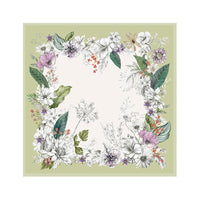
A landscape-print square scarf is a small piece of wearable composition. Unlike an all-over pattern, it has a clear focal area, a horizon, and often a decorative border, which means the way you fold it directly changes what people see. If you are considering the Wholesale Artistic Landscape Print Square Scarf Women Elegant Tree Design for your shop or personal wardrobe, this guide walks through how to identify the main motif, plan a fold that preserves it, and honestly assess what product photos can and cannot tell you before you commit to a purchase.

Why a Directional Print Behaves Differently When Folded
A directional print is one whose artwork appears oriented when the scarf is opened. A landscape-style composition may include a foreground, a focal area, and a surrounding scene. When you fold a square scarf with an all-over floral or geometric print, any triangle you form still reads as the same pattern. With a landscape-style print, one fold can leave a different part of the scene visible than another.
Before you fold, it helps to accept a simple rule: every fold you make will hide part of the artwork. Your job is to decide what should remain visible. The listing title for this scarf describes an elegant tree design, and the product photos show a landscape composition with a defined focal motif. Whether that motif ends up on your shoulder, at your collarbone, or tucked out of sight depends entirely on your fold plan.

Locating the Main Motif and the Border
Start by laying the scarf flat on a clean surface with the printed side up. Look at the whole square as if it were a painting. Ask three questions:
- Where is the main subject? On a landscape print, this is often a tree, a building, a mountain, or a figure that draws the eye first.
- Where is the horizon or the strongest horizontal line? This tells you which edge is meant to sit "down."
- Is there a border, and does it wrap all four sides evenly, or is it stronger on certain edges?
The product photos for the tree design scarf show a clear central motif and a decorative frame, but photos alone cannot confirm exactly how the border behaves at the corners, how symmetrical the print is, or how the motif sits relative to the true center of the fabric. A sample or seller clarification can resolve whether the motif is positioned as you need for a particular fold. If precision matters for your use case, this is something worth confirming with the seller or with a physical sample.

Fold-Planning Approach One: The Diagonal Frame
The first approach is the diagonal fold, which turns the square into a triangle. This is the most common way to wear a square scarf around the neck, and it works well when the main motif sits near the center of the square.
To plan it:
- Identify which two opposite corners you want to bring together. The fold line will run diagonally between the other two corners.
- Fold the square in half along that diagonal, wrong sides together at first, so you can see how the print collapses.
- Notice where the main motif lands. On a landscape-style print, a corner-to-corner fold may place a visible line of the scene at an angle; check the result before you commit to the arrangement.
- Try the other diagonal. Many landscape squares have one "better" diagonal because the artist composed the scene with a particular corner as the top.
The diagonal fold is forgiving because the motif usually remains partially visible on the front-facing triangle. The trade-off is that half the border disappears into the fold behind the neck.
Fold-Planning Approach Two: The Band Fold
The second approach is the band fold, which turns the square into a long rectangle. This is useful for headbands, bag handles, or a slim neck wrap.
To plan it:
- Decide whether the horizon of the landscape should run along the length of the band or across it. Running the horizon along the band usually keeps more of the scene visible.
- Fold the square in half, then in half again, and continue until you reach the width you want. Each fold halves the visible artwork.
- After each fold, pause and check which slice of the print is now on the outside. This is what the viewer will see. Everything else is hidden.
The band fold is the most demanding for a directional print because narrow bands often reveal only the sky, only the foreground, or only a border stripe. If the main tree motif sits in the center of the square, a tight band fold may cut through it and leave only branches or trunk on show. Planning the fold direction so that the motif runs along the band, rather than across it, usually preserves more of the scene. You can see the full artwork intended by the designer on the product page before you decide which direction suits your styling.
Checking Whether the Motif Survives the Fold
Once you have a fold in mind, do a visibility check before you tie or pin anything. Hold the folded scarf up in front of a mirror at the height you plan to wear it. Ask:
- Is the main subject still recognizable, or has it become an abstract shape?
- Does the visible line of the scene sit where you want it across the neckline?
- Is any part of the border visible? Borders often frame the face nicely when they land near the top edge of the fold.
- Would a stranger, glancing at you, understand that this is a landscape scene?
If the answer to the last question is no, try shifting the fold line by a few centimeters, or switch diagonals. Small adjustments often rescue a motif without requiring a completely different fold.
What Product Photos Can and Cannot Tell You
Product photography is excellent for showing color relationships, print layout, and the general character of a scarf. For this listing, the images can help you judge whether the tree design and the surrounding landscape appeal to your customers and whether the palette suits your range.
Photos cannot, however, prove how the fabric drapes when folded, how crisp the folded edges hold, how the print aligns at the exact center, or how the hem finishes at the corners. They also cannot demonstrate weight, hand-feel, sheerness, or how the scarf behaves after being tied and untied several times. Any claim about comfort, durability, or performance should come from your own handling of a sample, not from screen images.
A Short Sample-Check List Before You Commit
When you request a sample or receive your first unit, run through this quick check focused on fold behavior:
- Lay the scarf flat and photograph it from directly above for your own reference.
- Mark the position of the main motif relative to the true center.
- Test both diagonal folds and note which one keeps the motif more visible.
- Try a band fold in both orientations and see which preserves the scene.
- Check whether the border alignment feels even at all four corners.
- Fold and unfold several times to see whether creases relax naturally.
- Note anything that differs from what the product photos suggested.
Frequently Asked Questions
Which fold is most likely to keep a landscape motif visible?
There is no single fold that works for every directional print. Test both diagonals first, then compare them with a wider band fold. Choose the version that keeps the main subject recognizable at the viewing angle and wearing position you intend to use.
Can product photos prove how the scarf will drape after folding?
No. Photos can show the open print layout, colour relationships and visible borders, but they cannot prove hand-feel, fold crispness or movement. Those details require the actual scarf or a sample handled in the intended styling method.
What should I record when comparing fold directions?
Take one overhead photo of the open scarf, note where the main motif sits relative to the centre and photograph each test fold from the same distance. A consistent record makes it easier to compare the two diagonals and both band-fold directions without relying on memory.
Talk to Us Before You Order
If you are planning to stock this scarf or want clarity on details the photos cannot show, reach out to WomanScarf before placing an order. Ask WomanScarf for clarification on the print layout or additional reference images where available, and decide whether a sample is useful for your buying decision. You can view the full listing and start your enquiry on the product page for the Artistic Landscape Print Square Scarf with the elegant tree design, and our team will follow up with the specifics you need.
For a sample or a product-specific specification question, contact WomanScarf.