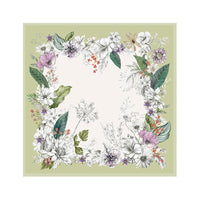
Choose a square scarf by the style you want to create, not by a size label alone. A 45–55 cm square works best as a compact accessory. A 70 cm square gives you more room for neck and hair styles. A 90 cm square is the most flexible starting point for fuller neck wraps, head-covering styles and light shoulder draping. At 110 cm and above, a square begins to behave more like a wrap.
These are practical ranges, not universal standards. Fabric thickness, grip, edge finish and the amount of fabric used in a knot can change how large a scarf feels.
Square Scarf Size Chart
| Approximate size | Inches | Best starting uses | What to expect |
|---|---|---|---|
| 45 × 45 cm | 17.7 × 17.7 in | Bag handle, wrist, ponytail, close neck knot | Compact ends and limited wrapping length |
| 55 × 55 cm | 21.7 × 21.7 in | Neckerchief, headband, hair accent | More visible than a mini square, still neat and light |
| 70 × 70 cm | 27.6 × 27.6 in | Classic neck scarf, hair wrap, simple head scarf | Useful balance of coverage and manageable volume |
| 90 × 90 cm | 35.4 × 35.4 in | Fuller neck ties, head-covering styles, shoulder drape | More coverage and longer ends after folding |
| 110 × 110 cm | 43.3 × 43.3 in | Shoulder wrap, layered head wrap, statement drape | Noticeably more volume; fabric choice matters |
If a product page lists a different dimension, use the actual finished measurement rather than trying to force it into one of these categories.
45–55 cm: Best for Small Accents
Small squares are useful when you want color and pattern without much bulk. Fold one diagonally or into a narrow band for a close neck knot, ponytail tie, wrist accent or bag-handle detail.
This size may feel too short for styles that need two wraps, long tails or full head coverage. Before buying, picture where the knot will sit and how much fabric must remain after it is tied.
70 cm: A Practical Mid-Size Square
A 70 cm square is a useful middle option. It can create a classic neckerchief, a broader hair band, a simple hair wrap or a compact head style. Compared with a smaller square, it leaves more fabric for a secure knot without creating the volume of a larger scarf.
It is still important to check the fabric. A crisp fabric can hold a structured shape, while a soft or slippery fabric may drape closer to the body and need a different tying method.
90 cm: The Most Versatile Starting Point
A 90 cm square gives you enough diagonal length for more varied folds and knots. It is a strong starting point when you want one scarf for fuller neck styling, head coverage or a light shoulder drape.
Larger does not automatically mean easier. A dense or stiff 90 cm scarf can feel bulky, while a lightweight version may collapse into a much smaller-looking knot. Check composition, weight, transparency and finish on the individual product page.
110 cm and Larger: More Coverage and Draping Room
Oversized squares work well when the goal is coverage, layering or a wrap-like silhouette. The extra area can support shoulder draping, more elaborate head wraps and statement folds.
The trade-off is volume. If you want a small neck knot or a minimal hair accent, an oversized square may require too many folds. Lightweight fabric can make a large size easier to manage, but the product specification should guide the decision.
Choose by Styling Method
For a neckerchief
Start around 45–55 cm for a close knot. Choose 70 cm if you want a looser drape, a larger triangle at the front or more visible tails.
For hair and ponytail styling
A 45–55 cm square can decorate a ponytail or form a narrow headband. A 70 cm square offers more room for wrapping and tying around thicker hair.
For head-covering styles
Start by checking the coverage you need. A 70 cm square may suit compact styles, while 90 cm or larger provides more area and longer ends. Hair volume, undercaps, layering and fabric transparency all affect the result.
For shoulders or a wrap effect
Look to 90 cm for a light drape and 110 cm or larger for more coverage. Compare the scarf's diagonal as well as its side length because many square-scarf styles begin with a diagonal fold.
Why the Diagonal Matters
When a square scarf is folded corner to corner, the folded edge is longer than one side. That diagonal is approximately the side length multiplied by 1.414.
| Side length | Approximate diagonal |
|---|---|
| 45 cm | 64 cm |
| 55 cm | 78 cm |
| 70 cm | 99 cm |
| 90 cm | 127 cm |
| 110 cm | 156 cm |
This explains why two scarves that look similar when laid flat can behave differently around the neck or head. The extra diagonal length changes how far the corners reach and how much fabric remains for a knot.
Material and Finish Can Change the Fit
Size is only one part of the choice. Before ordering, check:
- Thickness: thicker fabric creates a larger knot and more volume.
- Grip: smooth fabric can move more easily; textured fabric may stay in place more readily.
- Transparency: coverage depends on both size and opacity.
- Edge finish: rolled or bound edges can slightly affect the finished measurement and the way corners tie.
- Print placement: a border or central motif may appear differently after folding.
Do not assume every scarf in a collection has the same material or dimensions. Read the individual specification and ask for clarification if the listing is incomplete.
How to Measure a Square Scarf
Lay the scarf flat without stretching it. Measure from one finished edge to the opposite finished edge, then repeat in the other direction. A handmade or hand-finished scarf may vary slightly, so use the seller's stated tolerance when one is provided.
For a scarf you already own, test the intended fold and knot. Record both the side length and whether you wanted more or less fabric. That comparison is often more useful than relying on a generic label such as small, medium or large.
Quick Buying Checklist
- Choose the main styling use before choosing a size.
- Check the exact finished dimensions in centimeters or inches.
- Consider the diagonal length for triangle folds.
- Check thickness, grip, transparency and edge finish.
- Confirm that product images show the scarf folded or worn, not only laid flat.
- Compare the size with a scarf you already own when possible.
- Verify the individual product specification before ordering.
Frequently Asked Questions
What is the best all-purpose square scarf size?
A 90 × 90 cm square is a flexible starting point for many neck, head and light shoulder styles. It is not universal: smaller scarves reduce bulk, while larger scarves provide more coverage.
Is a 70 cm scarf large enough for a head scarf?
It can be for compact styles, but the answer depends on required coverage, hair volume, fabric and tying method. If you need longer ends or fuller coverage, compare a 90 cm square.
What size square scarf works around the neck?
Choose roughly 45–55 cm for a close neckerchief and around 70–90 cm for looser folds, larger front triangles or more elaborate knots.
Are scarf sizes standardized?
No. Labels such as small, medium and large vary by seller. Always use the listed finished dimensions.
How do I convert centimeters to inches?
Divide centimeters by 2.54. For example, 90 cm is about 35.4 inches.
Find the Size That Matches Your Style
Start with the styling method, then compare exact dimensions and fabric details. Browse the WomanScarf Square Scarf collection to see available formats, and verify the measurements and material on each individual product page before ordering.
Sources and Further Reading
- Design4Silk: Silk Scarf Size Guide
- Liberty: Scarf Styling Guide
- Hermès product guidance notes that hand-rolled scarf dimensions may vary.