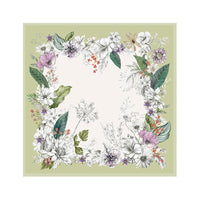
That beautiful, intricate pattern on your Paisley scarf is more than just a design—it's a piece of ancient history and a symbol rich with meaning. Have you ever wondered about the story behind those teardrop-shaped motifs? Let's unravel the fascinating journey of the Paisley pattern, from its sacred origins to its place as a global fashion icon.

A Symbol of Life and Eternity:
At its heart, the Paisley pattern is an ancient symbol of life and eternity. Its origins can be traced back to ancient Babylon, before it flourished in Persia and India .
The distinctive shape, reminiscent of a curved teardrop or a seed, is deeply rooted in symbolism. Many scholars believe it represents the "Tree of Life" from Hindu and Zoroastrian traditions, specifically a cedar tree or a sprouting palm leaf, symbolizing strength, immortality, and new beginnings . In India, it's also thought to resemble a mango, a fruit associated with prosperity and fertility . This connection to nature and life's continuity is why the pattern, known as Boteh or Buta in Persian and Indian cultures, has been cherished for millennia.

A Journey from East to West:
The pattern's journey to the Western world is a tale of trade and luxury. In the 18th and 19th centuries, exquisite Kashmiri shawls featuring this design were brought to Europe by the British East India Company via the Silk Road . They became a highly coveted luxury item among European aristocracy, so much so that a single shawl could cost as much as a small house !
As demand outstripped supply from India, European mills began producing their own versions. The town of Paisley in Scotland became the most famous and largest producer, using advanced loom technology to create shawls that blended the original motif with Victorian aesthetics . It was from this town that the pattern got its common English name.

More Than Just a Pattern: A Cultural Icon:
The Paisley pattern's appeal is timeless because it has continuously been reinvented.
-
The 1960s Psychedelic Movement:
The pattern saw a massive revival during the 1960s "Summer of Love." Its swirling, intricate shapes resonated with the psychedelic aesthetic, and icons like The Beatles wore it prominently, making it a symbol of bohemian style and counter-culture .
-
Rock, Hip-Hop, and High Fashion:
From the paisley-painted Rolls Royce of John Lennon to its adoption by rock stars like David Bowie and its association with hip-hop culture, the pattern has always maintained a cool, rebellious edge . Simultaneously, luxury fashion houses like Etro have built their brand identity around this elegant pattern, proving its versatility from the street to the runway .

Wearing a Piece of History:
When you choose a Paisley scarf, you are not just selecting a beautiful accessory. You are embracing a symbol of life, fertility, and eternity . You are wearing a pattern that has traveled across continents and centuries, from ancient rituals to royal courts and modern fashion weeks. It’s a design that carries the warmth of Indian craftsmanship, the luxury of European history, and the free spirit of rock and roll.
So the next time you wear your Paisley scarf, remember that you are wrapping yourself in a piece of art that has captivated the world for over a thousand years.
Explore our collection of Paisley scarves and find the one that speaks to your story. Each one is a unique blend of timeless beauty and profound meaning.
FAQs: All About Your Paisley Scarf
Q1: How should I style my Paisley scarf?
A: The beauty of Paisley lies in its versatility! For a classic look, pair a silk or fine wool Paisley scarf with a solid-colored coat or blazer. For a bohemian vibe, try a larger, fringed Paisley shawl with denim and boots. Don't be afraid to mix patterns—a small-scale Paisley can add a sophisticated touch when worn with stripes or a simple plaid. The key is to let the scarf be the statement piece.
Q2: Is the Paisley pattern only for women?
A: Absolutely not! The Paisley pattern is proudly unisex. Its history spans from the shawls worn by Mughal emperors and Persian royalty to iconic male rock stars. Today, you'll find Paisley patterns on men's ties, pocket squares, shirts, and scarves. It’s a timeless pattern that adds character and elegance to anyone's wardrobe.
Q3: How can I tell the quality of a Paisley scarf?
A: Look closely at the detail and execution. High-quality Paisley scarves feature sharp, intricate patterns with clear color definition, whether woven (like in Jacquard) or printed. Feel the fabric—premium materials like mulberry silk, cashmere, or fine merino wool are hallmarks of quality. Check the finishing: hand-rolled hems and secure, well-made fringe indicate superior craftsmanship. A good Paisley scarf is an investment piece that tells a story through its details.
Q4: How do I care for my Paisley scarf?
A: Care depends on the material. Always check the label first. For delicate silk or cashmere, hand washing in cold water with a gentle detergent is best. Lay it flat to dry away from direct sunlight to preserve the vibrancy of the colors. For sturdier wool or cotton blends, you may follow specific machine-wash instructions. When storing, fold it neatly rather than hanging to prevent stretching.
Ready to find a scarf with a story? Browse our curated collection of Paisley scarves, where timeless meaning meets modern style. Each piece is selected for its beauty, quality, and connection to this extraordinary design heritage. Have more questions? Our style consultants are here to help