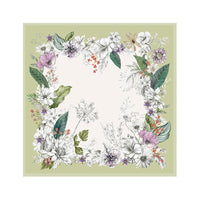
A scalloped-edge hijab is best chosen from the border inward. First check whether the curved edge continues evenly around the scarf, then see where the curves land after your preferred fold. Finished size, corner shape and real open-scarf photographs matter more than a decorative product name.
This approach is useful because a scalloped border is not a small detail once the scarf is worn. It can frame the face, form the front edge of a fold, appear along the shoulder line or become almost invisible if it is tucked inside. The right choice depends on the border placement you actually want to show.
What Makes a Scalloped Edge Different?
A straight scarf edge creates one continuous line. A scalloped edge uses a repeated sequence of rounded curves. The rhythm of those curves can be shallow and subtle or deeper and more decorative. Some designs place the scallops around all sides; others emphasize only particular sections.
That difference changes the visual result after folding. Along a face-framing edge, the curves create a softer outline than a straight hem. At a corner, the border may form a decorative point. Around the shoulders, a repeated edge can act almost like trim.
Do not assume that every curved-looking border is constructed in the same way. Product photos may show a printed scallop motif, a cut shaped edge, embroidery or another finishing method. If construction matters to you, ask the seller to confirm it rather than inferring it from a distant image.
Start With the Fold You Use Most Often
A square scarf is often folded diagonally before head or neck styling. That fold changes which edges remain visible.
- Exact corner-to-corner fold: two sides of the square become the main visible triangle edges.
- Offset diagonal fold: one corner sits below the other, allowing two layers or border sections to show.
- Narrow rolled fold: most of the broad border may disappear, leaving only small curved accents near the ends.
- Open shoulder placement: more of the perimeter remains visible, so border consistency matters across a larger area.
Before choosing a design, trace the fold across the open product image. Identify which sides will face outward and which will be hidden. This simple check prevents a common mismatch: selecting a scarf for its full border, then using a fold that conceals most of it.
Explore the featured WomanScarf square scarf gallery and compare the completely open view with the closer border photographs.
Read Size Before Judging the Curves
The featured square scarf is listed at 110 × 110 cm with a listed weight of 85 g. Those measurements describe this specific product, not a standard for every scalloped hijab.
Size affects how much of the border can remain visible after folding, wrapping and securing. To evaluate it, compare the listed square with a scarf you already own:
- Lay your familiar scarf completely flat.
- Fold it using your usual method.
- Note which edges remain visible and how much length is available at the ends.
- Compare its finished dimensions with the new listing.
Weight is a reference point, not a quality grade. It should be read beside the size and the confirmed material. Because the featured product page currently contains conflicting material labels, this guide does not make fabric-performance claims. Ask for a confirmed composition if material is important to your decision.
Inspect Four Border Zones
Instead of looking at the scarf as one large print, divide it into four zones.
| Zone | What to inspect | Why it matters |
|---|---|---|
| Long edge | Curve spacing and visual continuity | May become the face or shoulder frame |
| Corners | How the scallops meet at the point | Corners often remain visible after folding |
| Inner border | Distance between trim and center design | Changes how much pattern survives a fold |
| Reverse view | Whether the edge remains visually clear | Relevant when both sides appear in styling |
Zoom in far enough to see whether the curves are consistent. Check several gallery images rather than treating the first photograph as the entire product record. If multiple visual options appear together, reference the exact image you want when making an enquiry.

Separate Visible Evidence From Listing Language
Different parts of a product page answer different questions:
- Use the specification table for dimensions and listed weight.
- Use the open image for shape, border placement and design distribution.
- Use close-ups for the curves, corners and edge appearance.
- Use worn images only as examples of one arrangement.
- Use the option selector to identify the exact available visual choice when the mapping is clear.
Descriptions may use terms such as “premium,” “lightweight,” “voile,” “geometric” or “floral.” These words should not override conflicting specifications or unclear photographs. A careful buyer asks a narrow question—“What is the confirmed fiber composition for this exact image?”—instead of relying on a general product label.
Match the Border to the Rest of the Design
The scalloped edge should work with the part of the center design that survives the fold. A busy center plus a high-contrast border creates a stronger visual statement. A quieter center allows the curved edge to act as the main detail.
Consider three relationships:
- Border-to-background contrast: higher contrast makes every curve more visible.
- Border-to-corner placement: a centered corner motif can strengthen the pointed shape after diagonal folding.
- Border-to-outfit balance: if the clothing already includes embroidery, print or texture, decide whether the scarf should add another focal detail or provide a calmer frame.
These are styling decisions, not universal rules. The useful goal is consistency between the open design, your normal fold and the finished outfit.
A 60-Second Scalloped Hijab Checklist
- Is the scarf genuinely square, and what are its finished dimensions?
- Does the gallery show the entire scarf open?
- Are the curves visible along the edge I plan to display?
- How do the scallops meet at the corners?
- Will my usual fold reveal or hide the border?
- Is the material confirmed consistently?
- Can I identify the exact image or visual option?
- Do I need a close-up of the edge construction before ordering?
If the material or edge method is unclear, that is a specific enquiry item—not a reason to invent an answer from the photograph.
Frequently Asked Questions
Does a scalloped border change how a hijab is tied?
It does not require one universal tying method, but the fold determines whether the curved edge is visible. Test the diagonal and offset folds with a scarf you already own, then compare the new scarf’s dimensions and border placement.
Is a scalloped-edge hijab suitable only for formal outfits?
No fixed occasion can be inferred from the edge shape alone. Contrast, central design, outfit and styling method determine how decorative the finished look feels.
How can I tell whether the scallops are printed or cut?
Look for close-up edge photographs and a clear construction description. If neither is available, ask the seller to confirm whether the effect is printed, shaped, embroidered or made by another method.
What should I include in a product enquiry?
Send the product link, the exact gallery image, the quantity you are considering and your destination. Ask for confirmation of any conflicting material or construction detail that affects your decision.
Let the Border Lead the Decision
Choose a scalloped-edge hijab by following the sequence usual fold → finished size → visible edge → corner detail → confirmed specification. This keeps the decorative feature connected to the way the scarf will actually be worn.
View the 110 × 110 cm WomanScarf square scarf and its real gallery. For current product or wholesale details, contact WomanScarf with the exact image and the specifications you need confirmed.