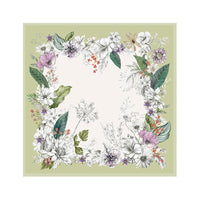
A skinny scarf should be selected for its intended job, not just its print. Start with finished width and length, then check where the motif lands after tying. A scarf that works well on a bag handle may behave differently as a hair ribbon or compact neck tie.
Choose the Styling Job First
For hair styling, inspect whether the strip is long enough for a secure knot plus visible tails. For a neck tie, compare the finished length with a scarf you already wear and decide whether you want one knot, a bow or a loose loop. For a handbag, measure the handle section you plan to wrap. These three uses consume length differently, so one attractive photo cannot answer every fit question.
Read Proportion, Not “Silk Feeling”
The featured product is listed at 145 × 12 cm and 42 g. Those figures describe its proportions; they do not prove how another skinny scarf will feel. The listing contains conflicting material labels, so this guide does not make a fiber claim. If composition affects care or sourcing, ask for written confirmation and a close-up before ordering.
Explore the featured WomanScarf product gallery and compare the open, close-up and styled views.

Inspect Print Placement After a Knot
A narrow scarf hides part of its design inside a knot or wrap. Look for full-length photos and identify the center, both tips and the border. A large motif near the middle may disappear around a handle, while detailed tips remain visible in a bow. If ordering multiple colors, compare the same zones on each option rather than assuming identical placement.
Use a Three-Test Sample Check
Tie the sample once around the neck, once around a ponytail or bun, and once around the intended bag handle. Record tail length, knot bulk, slippage and whether the visible print still looks balanced. A simple repeatable test is more useful than judging softness alone.
Quick Decision Checklist
Confirm the finished dimensions; identify the main use; trace which print zones remain visible; inspect both ends and borders; request confirmed composition when needed; and test one sample using the intended knot. For wholesale planning, photograph each test so buyers and staff evaluate every color consistently.
Match the Dimensions to the Tie
The same skinny scarf can look generous in a simple knot and too short in a layered bow. Before choosing, recreate the intended tie with a ribbon, measuring tape or scarf of known size. Mark the length used by the knot, the amount hidden around the neck, hair or handle, and the tail length that remains visible. This turns a vague preference into a repeatable requirement. For hair, also check whether the scarf will be tied around a ponytail, woven into a braid or wrapped around a bun; each method uses a different amount of length. For a bag, measure the handle circumference and decide whether you want one accent knot or a continuous wrap.
Check the Details That Narrow Formats Emphasize
A narrow format makes edges, tips and print alignment unusually visible. Inspect whether both long edges look even, whether the tips are shaped consistently and whether the print appears balanced when the scarf is folded lengthwise. A full-width product photograph is useful, but a buyer also needs a close-up of the edge and an image of both ends. If several colors or prints are offered, compare equivalent views instead of assuming that every option has identical motif placement. A sample should also be tied and untied several times to reveal how the edge behaves around a small knot. Record what you observe without turning one sample into a claim about all production.
Build a Practical Styling Test
Use the same three ties for every candidate: one compact neck knot, one hair application and one bag-handle application. Photograph the front and back of each result. Note whether the motif remains visible, whether the tails are balanced and whether the knot becomes bulky for the intended scale. For boutique buying, this small image set can help staff explain the product without promising that every customer will achieve the same fit. It also helps identify which use should lead the product description and which uses should remain secondary suggestions.
Common Buying Mistakes
Do not choose only from a tightly cropped styled image, confuse a glossy appearance with confirmed fiber composition, or assume that “one size” means every tie will work. Avoid copying a supplier’s price, stock or delivery statement into evergreen content because those details can change. Another common mistake is presenting every possible use as equally successful without testing the actual proportions. A focused promise—such as a narrow accessory designed for flexible styling—is clearer than an unsupported claim that it is perfect for every hairstyle, neck tie and handbag.
Frequently Asked Questions
What should I measure before buying a skinny scarf?
Measure the usable length and finished width, then compare them with the knot or wrap you intend to make. For a bag handle, include the handle circumference. For hair, allow enough length for the anchor point and visible tails.
Does “silk feeling” confirm that a scarf is silk?
No. It describes a marketing impression, not a verified fiber composition. Ask for a current material specification when composition affects care, labeling or purchasing requirements.
Is a longer skinny scarf always more versatile?
Not automatically. Extra length can support more wraps, but it may also create larger knots or longer tails. Proportion should be evaluated against the intended style.
What should a wholesale sample record include?
Keep the product reference, color or print reference, confirmed dimensions, dated photographs of the full scarf and both tips, and images of the planned ties. Add any questions that still require supplier confirmation.
Final Takeaway
Choose from evidence you can repeat: current specifications, complete product photos and a sample test based on the intended use. Avoid treating price, stock, minimum order quantity or delivery timing as permanent; confirm those details in a current enquiry.
View the featured product or contact WomanScarf with the product link, intended use and the details you need confirmed.