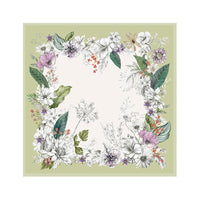
How to Inspect Embroidery Placement on a Long Hijab
Embroidery placement determines what remains visible after a long hijab is folded and wrapped. Inspect the scarf as a map: center field, long edges, short edges and corners. Then test the exact fold you plan to use before judging whether the decoration supports that style.
Create a Flat-Lay Map
Photograph the full scarf from directly above. Mark the centerline, each end and every decorated zone. Close-up images are useful for stitches, but only a complete flat view shows how motifs relate to one another. Keep the product ID and color reference in the image record.
Trace the Intended Fold
For a head wrap, mark the edge that will frame the face and estimate where the first turn around the head begins. For a shoulder shawl, identify the center-back point and the two visible ends. Decoration near a hidden fold contributes differently from a motif placed at an exposed corner.
Explore the featured WomanScarf product gallery and compare the open, close-up and styled views.

Use Dimensions as a Map Scale
The featured product is listed at 165 × 90 cm and 122 g. Use those figures to compare with a familiar scarf and to estimate where motifs may land. Because product text can change, confirm the finished measurement and composition on the current sample before approval.
Inspect Repeatability
Compare the same motif on both ends and across available colors. Look for alignment, complete stitching, clean edge transitions and visible loose threads. If hand or machine processes allow placement variation, ask the supplier to define the acceptable range rather than expecting photographic identity.
Approve the Evidence Set
A useful approval record includes one full flat lay, both ends, all corners, a close-up of the embroidery, a styled view and the confirmed specification. For a bulk enquiry, reference that exact evidence set and ask how production will be checked against it. This connects editorial guidance to a concrete buying action.
Divide the Scarf Into Repeatable Zones
Create a simple grid for the center field, face-framing edge, opposite long edge, both short ends and four corners. Number the zones and use the same labels in photographs and supplier comments. This avoids descriptions such as “the flower on the left,” which become ambiguous when the scarf is rotated. Include a ruler or defined reference when motif distance from an edge matters, but confirm the finished scarf dimensions before turning that distance into a specification.
Test More Than One Styling Route
Use one fold for a face-framing hijab style and another for a shoulder or shawl presentation. Photograph each stage: initial fold, first placement, wrapped view and visible ends. Mark which embroidery zones disappear, overlap or become focal points. A design that looks sparse in a flat lay may be balanced after folding, while a prominent central motif may be hidden. The test should explain placement, not claim that one styling route is correct for every wearer.
Inspect the Transition Between Embroidery and Edge
Close-up review should include the beginning and end of embroidered runs, corners, border changes and areas where stitching approaches the finished edge. Look for incomplete motifs, visible loose threads and differences between repeated elements on the sample. If decoration varies by color, capture equivalent zones in each option. Ask the supplier how normal placement variation is defined. Do not assume that a handmade appearance or machine consistency applies unless the production method is confirmed.
Turn the Sample Into a Production Reference
Store the product ID, color reference, date, confirmed specification and complete image set together. Identify which observations are accepted and which require clarification. When placing an enquiry, reference the approved evidence rather than saying only “same as the photo.” Ask how later production will be compared and what happens if embroidery placement falls outside the agreed range. Keep price, quantity, availability and timing in the current enquiry because those facts can change.
Compare Colorways Without Losing Orientation
Use the same scarf orientation and zone numbers for every color. Photograph the face-framing edge at the top, keep the same corner as the starting point and repeat the same fold sequence. Otherwise, a rotated scarf can make identical placement appear different. Compare motif contrast and visibility as observations, not promises about exact screen color. If multiple product images use different lighting, request a consistent color-reference set before approving an assortment. The goal is not to force every colorway to look identical, but to confirm that each follows the agreed placement logic.
Frequently Asked Questions
Why is a full flat-lay photograph necessary?
Close-ups show stitching, but only a full view shows the relationship between motifs, borders, corners and the center field.
Should embroidery be perfectly identical on every piece?
Do not assume photographic identity. Ask the supplier to define acceptable variation for the actual production method and order.
Can dimensions predict where a motif will appear when worn?
They provide a scale, but folding and placement change the visible result. Confirm measurements and test the intended style on a sample.
What belongs in an approval set?
Include a full flat lay, numbered zone close-ups, both ends, all corners, styled sequences, confirmed specifications and written notes on accepted variation.
Make the Enquiry Specific
Reference the exact product and color, attach the numbered placement map and identify the styling route that matters. Ask the supplier to confirm finished dimensions, current composition, the approved embroidery reference and the range of acceptable placement variation. Request equivalent photographs when comparing colors. Keep price, quantity and timing in the dated enquiry rather than the evergreen guide. When the reply arrives, update the approval record before updating customer-facing claims. This closes the gap between visual inspection and a purchasing decision without asking readers to trust an unsupported quality label.
Final Takeaway
Choose from evidence you can repeat: current specifications, complete product photos and a sample test based on the intended use. Avoid treating price, stock, minimum order quantity or delivery timing as permanent; confirm those details in a current enquiry.
View the featured product or contact WomanScarf with the product link, intended use and the details you need confirmed.