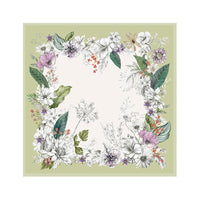
A triangle scarf is usually the easier choice when you want a ready-made point with less folding. A square scarf gives you more control over how deep that point becomes because you create the triangle yourself. Neither shape is automatically better: the useful choice depends on where you plan to wear it, how much fabric you want around the knot and whether you prefer a repeatable shape or an adjustable fold.
That distinction matters more than trend labels. Two scarves can look similar in a styled photograph while behaving differently when opened. Before choosing, compare the starting shape, finished dimensions, usable tie length and the parts of the design that will remain visible.
The Main Difference Is the Starting Shape
A square scarf begins as four equal sides. To create the familiar pointed kerchief shape, you fold it diagonally. You can align the corners exactly for a full triangle or offset them to make the point shallower and leave more fabric in the tying ends.
A pre-cut triangle scarf already has a long top edge and a center point. There is no doubled diagonal fold unless you decide to roll or narrow the edge. That makes the silhouette easier to repeat: open it, place the long edge where you want it and work with the two end points.
The tradeoff is control. A square lets you change the depth of the triangle through folding. A triangle removes that preparation step, but its proportions are fixed by the cut. If the point is deeper or the ends are shorter than your preferred style requires, folding cannot create extra fabric.
You can see the ready-cut format in this WomanScarf triangle scarf product gallery. Use the open-shape photographs to judge its proportions before focusing on the print.
Compare What Happens After Folding
The easiest way to understand the two formats is to compare the fabric distribution rather than the flat area.
| Decision point | Pre-cut triangle scarf | Square scarf folded diagonally |
|---|---|---|
| Preparation | Starts with a point already formed | Requires a diagonal fold |
| Point depth | Set by the cut | Adjustable by shifting the fold |
| Fabric layers | Usually one layer across the main triangle | Usually doubled after folding |
| Tie ends | Determined by the triangle’s proportions | Can change slightly with the fold |
| Repeatability | Easier to reproduce the same outline | Offers more variation between wears |
| Design placement | Border and point are designed for the triangle | Square artwork changes when folded |
These are construction differences, not guarantees about comfort, coverage or staying power. Material, finish, dimensions and the way a scarf is secured still affect the final result.
Read Triangle Scarf Dimensions in Three Parts
A single number rarely explains how a triangle scarf will fit into a styling plan. Look for three measurements:
- Longest edge: the top edge that sits around the head, neck or shoulders.
- Vertical depth: the distance from the center of that edge to the lowest point.
- Side lengths or usable ends: the fabric available to cross, knot or leave loose.
The longest edge affects how much room you have to position and secure the scarf. The depth affects how far the center point falls. The side proportions influence whether the ends can meet comfortably for the intended arrangement.
Do not compare a triangle’s longest edge directly with one side of a square and assume they offer the same finished shape. A square creates its working edge along the diagonal after folding. A pre-cut triangle uses the dimensions it already has. When listings use different measurement conventions, sketch the shape and label the numbers before comparing.
The featured WomanScarf example is listed as 130 × 87 cm and 32 g, with a polyester composition. Those facts describe this product only; they are not universal triangle-scarf standards.
Choose the Shape From the Finished Use
Start with the position you expect to use most often.
For a hair kerchief
A ready-cut triangle removes the first diagonal fold and gives you a consistent center point. Check the longest edge and the end length rather than assuming every triangle can be tied in the same way. Inspect open and worn photographs to see where the border falls and how much of the point remains visible.
For neck styling
Decide whether you want a defined point or a narrower rolled band. A pre-cut triangle makes the pointed front straightforward. A square offers more ways to adjust the fold before rolling, which may be useful if you alternate between a broad kerchief and a slim neck tie.
For shoulder draping
The depth becomes especially important. A shallow triangle and a deep triangle can share a similar longest-edge measurement but fall very differently across the back or chest. Use the open-shape image and the stated depth together.
For head covering
Do not infer coverage from the word “triangle” or from a close-cropped model image. Compare the exact finished measurements with a scarf you already use, then consider the placement, overlap and securing method required for your preferred coverage. Ask for clarification when the listing does not show the full shape.
Inspect the Design as a Triangle, Not as a Flat Print
On a ready-cut triangle, the outer border, center point and two ends do different visual jobs. The border frames the face, neckline or shoulder line. The point becomes the central visible area. The ends may form the knot or hang as accents.
Before choosing a visual option, trace those three zones in the product photo. Ask:
- Does the border continue cleanly along the longest edge?
- Which motif sits at the center point?
- Are the two tying ends visually similar?
- Does the product gallery show the scarf completely open?
- Can I identify the exact image when making an enquiry?
This is more useful than choosing from a color name alone. Similar colorways can place their borders and motifs differently, producing a different finished look.

The product title and attribute table currently use different pattern labels, so this guide does not assign a pattern category. The real gallery is the better reference for identifying the design you want.
Use a Product-Page Evidence Check
Evaluate each part of the listing for the job it can actually do:
- Specifications: shape, dimensions, material and listed weight.
- Open product image: proportions, border placement and center point.
- Worn image: one possible arrangement, not proof of universal fit.
- Option selector: the exact selectable choice, when clearly mapped to an image.
- Product title: useful orientation, but not a substitute for measurements.
If these elements disagree, pause before choosing. A polished title cannot resolve a measurement conflict, and a styled photograph cannot verify fiber composition. Ask about the specific missing fact rather than requesting a general confirmation that the product is “good.”
A 60-Second Shape Checklist
- Do I want a ready-made point or an adjustable diagonal fold?
- What is the longest edge?
- How deep is the center point?
- Are the tying ends long enough for my intended arrangement?
- Is the material stated clearly?
- Does the gallery show the scarf completely open?
- Which border and motif will remain visible?
- Can I reference the exact product image when enquiring?
If you cannot answer the first four questions, the shape information is not yet complete enough for a confident comparison.
Frequently Asked Questions
Is a triangle scarf easier to wear than a square scarf?
It can be easier when you want a repeatable pointed shape because the diagonal fold is already removed. A square may be more flexible when you want to adjust the depth of the point or change between broad and narrow folds.
Is a triangle scarf the same as a square scarf folded in half?
They can create a similar outline, but they are not identical. A folded square usually creates two fabric layers and lets you shift the diagonal fold. A pre-cut triangle has fixed proportions and usually begins as one main layer.
What triangle scarf size should I choose?
Choose from the intended use rather than one universal size. Compare the longest edge, vertical depth and usable ends with a scarf or tying arrangement you already know. The featured product is listed at 130 × 87 cm, but that does not make it a standard for every use.
What should I send with a triangle scarf enquiry?
Send the product link, the exact gallery image you mean, your intended use, the quantity you are considering and your destination. Ask separately about any current commercial detail that is important to your decision.
Choose the Shape Before the Print
The most reliable order is use → shape → dimensions → visible design → product check. Choose a triangle scarf when a ready-cut point and repeatable outline suit your plan. Choose a square when adjustable folding and multiple starting shapes matter more.
Explore the 130 × 87 cm WomanScarf triangle scarf and its real product gallery. For current product, wholesale or customization details, contact WomanScarf with the exact image and requirements you want reviewed.